 AYA CORE
Where Will Big Tech's Trillions Go? And Why Lamb at $500 Still Costs 0.8 AYA
Big Tech is pouring close to $3 trillion into data centers. That money doesn't burn. It flows into concrete, power plants and paychecks, and it pushes up the price of everything, including your groceries. This article walks through a simple idea: price everyday goods in AYA, a coin with a fixed supply, so that if lamb climbs from $11 to $500 in dollars, it still costs the same 0.8 AYA.
Oracle, Microsoft, Amazon, Google and Meta are racing to build data centers. China's Highlander has sunk commercial servers into the sea. Lonestar has flown a data center to the Moon. Starcloud has put an Nvidia H100 into orbit. Soon the only place without a data center will be your grandmother's kitchen. Give it time.
Morgan Stanley puts global data center spending at about $2.9 trillion through 2028. The headlines say this money is being "burned." Relax. Nobody is burning anything. Money in the investment world doesn't vanish. It just changes clothes.
The great circle of promises
Here's how the game works. OpenAI signed up to buy about $300 billion of computing power from Oracle over roughly five years (reported September 2025). To deliver it, Oracle has to build, and to build, it has to borrow. And where does OpenAI get the money to pay? Partly from investors who, in turn, sell it chips and cloud. Everyone promises to buy everyone else's product, and everyone books it as future revenue.
What exactly is going on there (let's call it a mutual admiration society with very large spreadsheets) is a topic for another article. My question is simpler. When this money lands, where does it land? And if the buyer can't pay even a fraction of the bill on time, who eats the loss?
Because sooner or later, money made of promises hits something made of physics:
- Concrete, steel, copper, transformers, cooling. Teraflops don't grow on trees. They grow in very expensive buildings.
- Energy. AI doesn't sleep, and the sun and the wind sometimes do. Morgan Stanley already sees a 38-gigawatt power gap for US data centers, and the quickest fix is gas. Whatever happened to "saving the planet"?
- People. Tens of thousands of builders, electricians and engineers get paid in real, spendable dollars.
Some of that will go into bank deposits. Some will go into beer. Both are fine choices. But the big picture is clear: trillions of dollars that existed mostly as promises are about to pour into the real economy, all at once.
The planet will be fine. Your wallet, less so.
A quick aside. The planet doesn't need saving. It has survived being a scorching greenhouse and a snowball frozen down to the equator. It will shrug this off too. What needs saving is us: people, animals, plants. Mostly from our own economic creativity.
When trillions start competing for the same limited things (electricity, metal, food, water) you don't get a little inflation. You get prices moving to a whole new floor. When power grids and steel mills are busy feeding data centers, baking bread and raising sheep get more expensive.
Will a kilogram of lamb cost $500? Maybe not tomorrow. But ask anyone who has been to a supermarket lately whether "impossible" still feels like the right word.
A ruler that doesn't stretch
Think of the dollar as a rubber ruler. Every year someone stretches it a little. Your sofa hasn't changed, but suddenly it "measures" 3 meters instead of 2. Did the sofa grow? No. The ruler got worse.
AYA is an attempt to make a steel ruler. Here's the idea in its simplest form: inside the AYA ecosystem, everyday goods are priced in AYA, and those prices stay put.
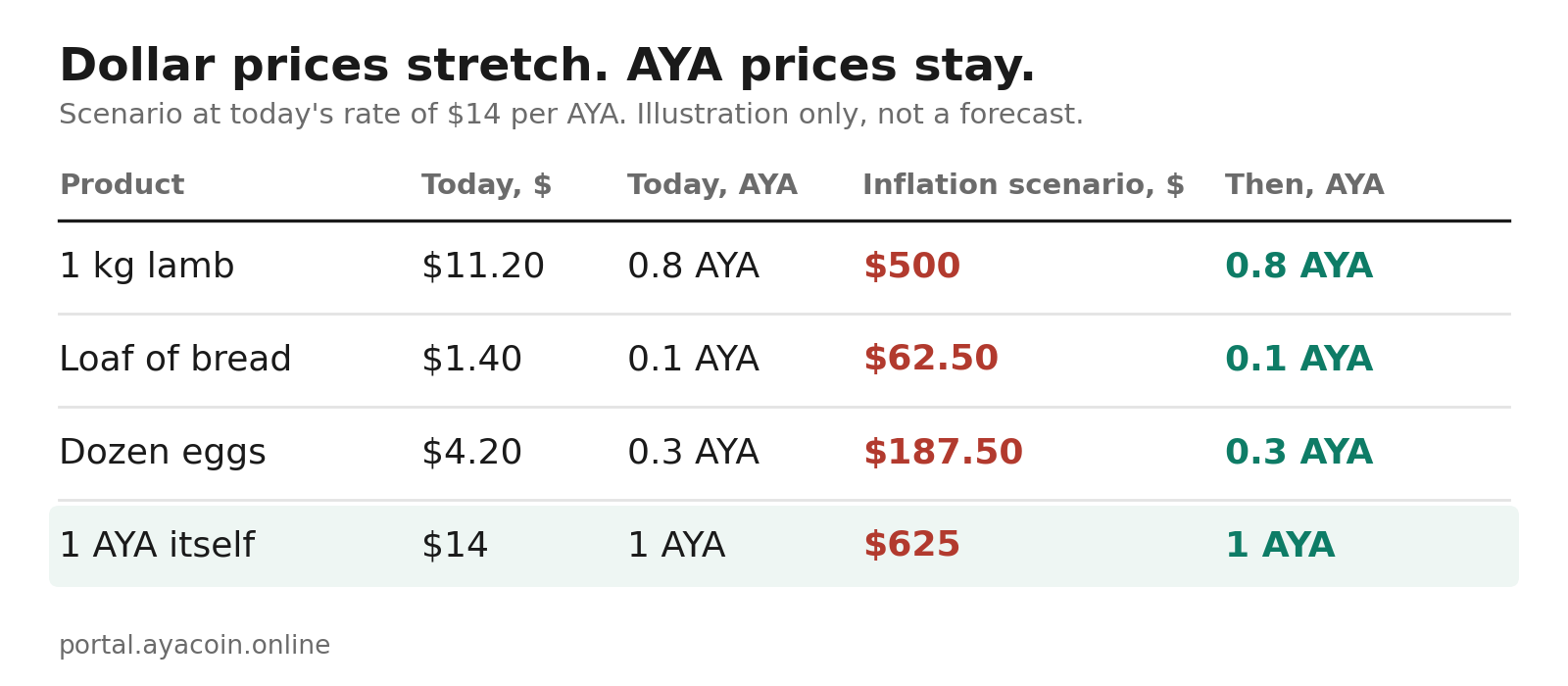
The lamb didn't change. The bread didn't change. Only the rubber ruler got stretched. If lamb goes to $500 and still costs 0.8 AYA, then one AYA now buys what $625 buys, not $14. You didn't get richer. You simply didn't get poorer.
Put another way: 10 AYA today buys 12.5 kg of lamb. In two years it still buys 12.5 kg of lamb, whatever the dollar is doing.
Why AYA can try to be that ruler
Fixed supply. The total supply is tied to the 635,835 symbols of the canonical genesis text. No printer, no mining inflation, no committee deciding to "add a little liquidity." Whatever else happens, the ruler can't be stretched from the inside.
No exchange casino. AYA isn't traded on crypto exchanges, so there are no market-maker games and no bots pumping and dumping the price overnight. Exchange happens directly, through built-in peer-to-peer mechanisms.
Built for the quantum threat. Transactions and wallets are signed with a post-quantum signature standard designed to hold up against future quantum computers.
The honest part
Let's be straight: this is an experiment. A fixed price in AYA works only as long as the people selling goods in the ecosystem agree to hold it. Nothing here is guaranteed. Not by us, and frankly not by central banks either, whose "stable 2%" promise is aging about as well as milk.
So don't take our word for it. Open the wallet, look at how prices work inside, and decide for yourself. Humanity spent three centuries trusting banks. Maybe it's time to give code a look.
AYA CORE is a post-quantum Layer-1 blockchain built from scratch in Rust. Read the documentation at portal.ayacoin.online/docs, verify what the network records through the public AYA CORE Explorer, and hold the keys yourself: the wallet runs at ayacoin.online and is available on the App Store and Google Play.
This article is educational and does not constitute financial or investment advice.