 AYA CORE
Paid, Not Received: How a Bitcoin Payment Vanishes by the Network's Own Rules
A seller sees an incoming Bitcoin payment and hands over the goods. Ten minutes later, the buyer has both the goods and the money. The seller has a life lesson.
Nobody hacked anything. No keys were stolen, no passwords guessed. The buyer used a feature that is built into Bitcoin and described in its open documentation. It is called Replace-By-Fee, or RBF.
Let's look at how the trick works, who came up with it, and how AYA handles the same moment differently.
How the trick works
A Bitcoin transfer becomes final only when it lands in a block. Until then, it waits in the network's shared queue, called the mempool.
- The buyer sends bitcoin with a tiny fee — a few cents. Miners have little interest in such a transfer, so it can sit in the queue for a long time.
- The seller's wallet already shows the incoming amount. The seller hands over the goods.
- Before the transfer lands in a block, the buyer cancels it in their own wallet. The popular Electrum wallet has had this cancel option built in since 2020.
- The same coins go to another address of the buyer — this time with a fee of $5–7.
- Miners pick the transfer that pays more. The new one lands in a block, and the old one simply disappears, as if it never existed.
The scammer spends a few dollars in fees to keep thousands. Excellent margins — and all strictly by the network's rules. The network's rules were not broken. The law was: this is plain fraud.
A hole, or by design?
By design — and nobody hid it. Transaction replacement has been discussed in the open since Bitcoin's early years:
- 2009–2010. Transaction replacement exists in Bitcoin's original version. In 2010, Satoshi Nakamoto switches it off in version 0.3.12, with a code comment: "Disable replacement feature for now." The reason was spam: anyone could broadcast endless replacements and pay a fee for only one of them.
- 2015. Developers Peter Todd and David Harding describe replacement again, as the BIP 125 standard. A sender can mark a transfer as replaceable.
- 2016. The standard ships in Bitcoin Core 0.12. The goal: to push through a transfer stuck in the queue because of a low fee.
- October 2024. Bitcoin Core 28.0 enables replacement by default for any unconfirmed transfer, marked or not.
Satoshi's "for now" lasted six years. In IT terms, that is almost forever.
The developers' position is simple: a transfer without a block is not money yet. RBF did not create this problem; it made it obvious. Double-spending an unconfirmed transfer was possible before, too — it just took more skill.
Why the victim's balance "doesn't go down"
After the replacement, the seller's wallet sometimes keeps showing the old amount for a while. That is a wallet defect, not a network one: the wallet counted an unconfirmed transfer in the balance and didn't remove it after the replacement.
This is exactly what happened in Ledger Live in 2020. The wallet added incoming amounts to the balance right away and didn't reduce it after an RBF cancellation. Ledger published its own analysis of the bug and fixed it in version 2.7.0.
Ledger Live was quite the optimist back then: it counted money that hadn't arrived and didn't notice money that had already left.
The check is simple: open the transfer in a block explorer such as mempool.space. "Unconfirmed" means it is not money yet. It is a promise.
Even a block is not an iron guarantee
A confirmation in a block is not absolute either. Whoever controls more than half of a network's mining power can rewrite its latest blocks. This is called a 51% attack.
In late July 2020, Ethereum Classic was hit exactly this way. The attacker rented mining power for about $192,000 and rewrote thousands of already confirmed blocks. The double spend came to about $5.6 million.
Spend $192,000, walk away with $5.6 million. A business plan nobody should copy.
In Bitcoin, such an attack costs incomparably more. That is why large amounts are accepted after 3–6 blocks. One block takes ten minutes on average — just enough for a cup of coffee. Six blocks are enough for a proper conversation over coffee and dates.
A checklist for sellers who accept bitcoin
- The money is yours only after a block. Large amounts — after 3–6 blocks.
- Don't trust the wallet balance: check the transfer in a block explorer.
- Since 2024, any unconfirmed transfer can be replaced — with or without an RBF flag.
- A tiny fee plus a buyer in a hurry is a reason to wait twice as long.
How AYA handles it
In AYA, an incoming transfer does not land in the balance on its own. The recipient sees a "+N from …" line with an Accept button. Until they press it, the money isn't theirs yet — and the wallet says so honestly.
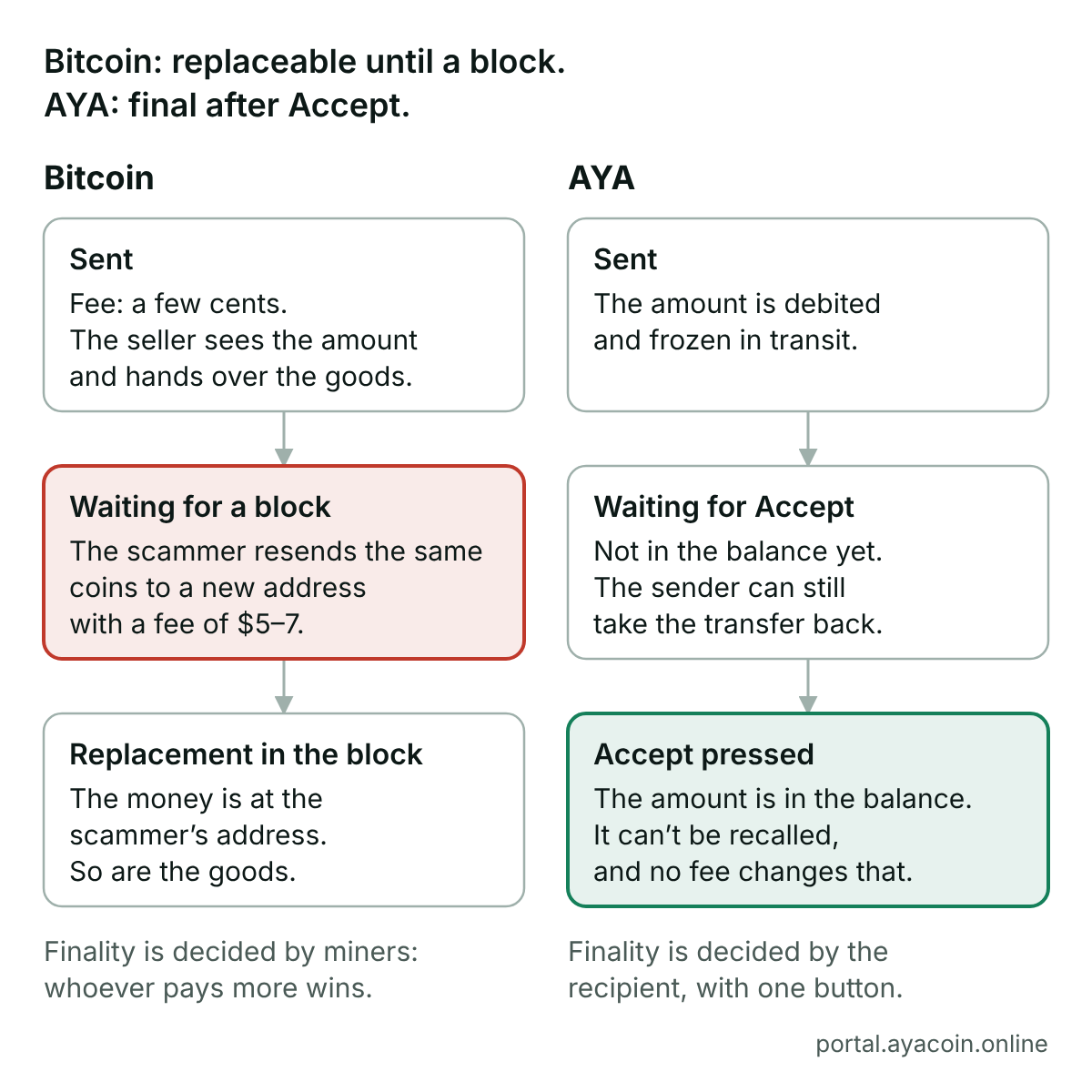
In Bitcoin, the moment of finality is decided by miners, and the sender can influence it with a fee. In AYA, that moment is decided by the recipient — with one button.
- Before Accept, the sender can take the transfer back. That protects against a typo in the address: a mistake costs only the fee.
- After Accept, there is no way back. A transfer can be accepted or returned only once: once it is accepted, there is nothing left to return.
- The fee decides nothing. Accept can't be outbid — not by replace-by-fee, and not by replace-by-friend.
The seller's rule is the same as in Bitcoin, only simpler: hand over the goods after Accept. Not after a "sent" screenshot, and not after a "+N" line.
AYA, honestly
Today, the nodes of the AYA network are run by the AYA CORE team. The rule "an accepted transfer can't be recalled" is written into the protocol, not into a promise. But a sceptic has every right to ask: couldn't the operator rewrite the database?
The honest answer: the more independent nodes there are, the less you need to take our word for it. That is why we invite partners to run their own nodes. The next step is quorum signatures from independent validators on the network's records. Then nobody will be able to rewrite history alone — including us.
The bottom line
Bitcoin doesn't lie. It just speaks a language few people have learned: in it, "sent" doesn't yet mean "received."
The scammer lives in the gap between those two words. In AYA, there is one button between them — and the recipient is the one who presses it.
AYA CORE is a post-quantum Layer-1 blockchain built from scratch in Rust. Read the documentation at portal.ayacoin.online/docs, verify what the network records through the public AYA CORE Explorer, and hold the keys yourself: the wallet runs at ayacoin.online and is available on the App Store and Google Play.
Sources
- BIP 125: Opt-in Full Replace-by-Fee Signaling — authors, 2015; replacement switched off in version 0.3.12
- The Block: A historical look at Replace-by-Fee — why Satoshi disabled replacement
- Bitcoin Core 28.0 release notes — replacement on by default, October 2024
- CriptoNoticias: cancelling unconfirmed transactions in Electrum — Electrum 4.0.4, October 2020 (in Spanish)
- Ledger Donjon, LSB 012 — the Ledger Live balance bug, fixed in version 2.7.0
- Cointelegraph: 51% attack bleeds more than $5m from Ethereum Classic — July–August 2020
- AYA CORE Docs — how Accept and returning a transfer work
This article is educational and does not constitute financial or investment advice.